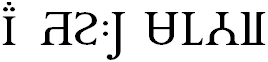
This is an experimental script for Pali, the ecclesiastical language of Buddhism. Pali is normally written in the Sinhala, Khmer, Burmese, Devanagari, Lao or Thai scripts, or with the Latin alphabet using diacritics. The current script has shapes based on those of ancient Brahmi and Pallava, which were the ancestors of the Indic scripts just mentioned. It aims at a unified, linear effect, without complicated vowel placement or diacritics. The name means Alphabet of the Sage. The font shown here has a Greco-Roman serifed style, perhaps we can call it Gandharan.
Consonants
Most letters are quite easily recognizable from their counterparts in other Indic scripts. As with almost all Indic scripts, and different from Ariyaka, consonants have an inherent short /a/ if no vowel letter is written.
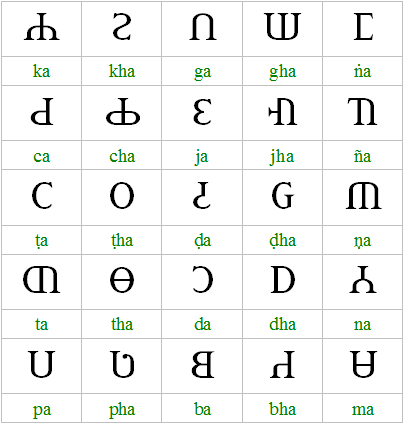
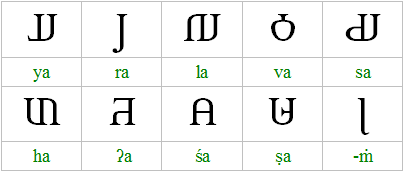
The glottal plosive acts as a prefix for initial vowels, as is found in many Indic scripts. The two extra /s/ glyphs are for Sanskrit words. The dotted /m/ suffix is a vowel nasalizer, being a common Pali morpheme. It may be noted the retroflex laterals are not encoded; they are considered allophones of the retroflex plosives, emerging in speech when between vowels.
Vowels
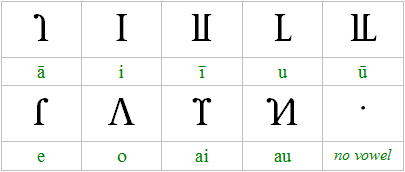
The written vowels follow their consonants in all cases, in a linear, single-channel manner; this is unlike most Indic scripts, whose vowels end up all over the place. The /ai/ and /au/ glyphs are for Sanskrit words. A “no vowel” mark may be used to cancel the inherent short /a/, as is required for consonants which close a syllable.
Punctuation etc
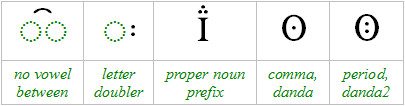
The “no vowel between” mark is for non-final, cluster or sandhi situations where the consonants run together. Where a consonant is doubled, a colon-shape is used in place of the second component. Note that where an aspirated consonant is doubled, an unaspirated form arises as the first component of the gemination; in Akkhara Muni, only the aspirated consonant is written, and any loss of aspiration due to doubling is ignored in writing.
Please note that Akkhara Muni seeks to capture the phonetics of the Pali language, and not duplicate existing systems of spelling. Even so, some further work may be required to deal with all phonological conditions adequately, and/or simplify common morphological situations.
Examples
These are based on my own poor reading of the Romanized Pali, and so may not perfectly reflect the classical pronunciation. Ideally, we will want to read and hear something close to what the Buddha himself might have said.
1. This is the first verse of the Dhammapada.


“Mind precedes all mental states, mind is their chief, they are all mind-wrought.
If a person speaks or acts with an impure mind,
Suffering follows him like the wheel follows the foot of the ox.”
2. This is the 154th verse of the Dhammapada.
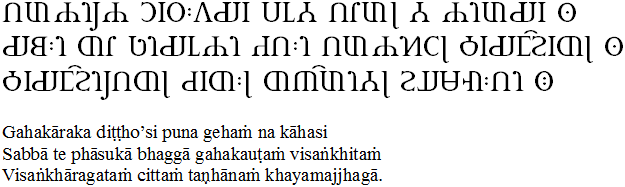
“Oh house-builder! You are seen, you shall build no house (for me) again.
All your rafters are broken, your roof-tree is destroyed.
My mind has reached the unconditioned; the end of craving has been attained.”
A version of this page can also be found on
Omniglot.
(You may like to offer motivation for further development :)
See also:
Thai and Lao for writing Pali, and
the Ariyaka script created by King Rama IV of Siam.