

This is a syllabary, where vowels are attached directly to their consonantal onset. Like my SIGIL scripts and others in the Phonological Cyphers series, glyphs are assembled in a regular manner from phonetic components. The design and explanation are pretty straight-forward. This is a major revision of one of my neglected scripts.
Consonants
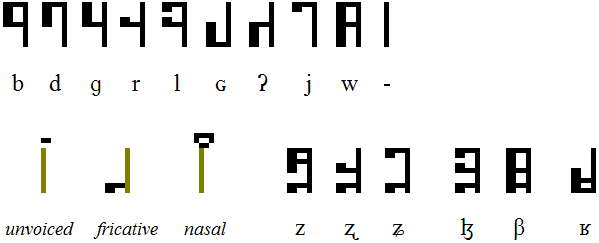
On the left side of a full syllabic glyph (CV) is a consonantal onset. There are base forms, relating to phonemic regions, and representing voiced plosives plus a few semi-consonantal phonemes. To a consonant base may be added a modifier, to effect devoicing and/or frication, or to make a nasal. The important phonemes [z] and [s] are derived from [d], and a few less common sibilants come directly from the [r], [j], [l] and [w] base glyphs. Notice how the frication bar will be a bit higher for the uvular glyph.
Vowels
On the right side of a full syllabic glyph is a single vowel. Roundedness is indicated by a stroke on the lower half. For final consonants, the “no vowel” vertical is attached to the C. For solo vowels, the “no consonant” vertical is attached to the V. Clearly, two null verticals will form a null syllable and thus can be used as a caesura.

Sample text
This is the Shakespeare transliteration again, the first line of his 18th Sonnet.

Shall I compare thee to a summer’s day?